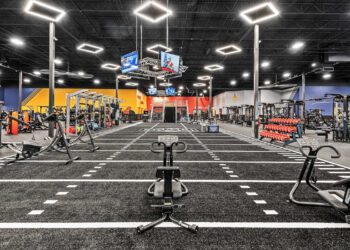
On January 26, 1992, the Americans with Disability Act (ADA) was put into effect. Frankly, many of us who were in the business of providing sport and athletic flooring did not give it a lot of attention at that time. We thought that the disabled were not really in the practice of being involved in a lot of the activities in the typical health club. Certainly, all governmental installations needed to comply as well as some corporate facilities, and rehab clinics, but we felt that other than that, no one would really be expected to comply.
Since then we’ve all realized that the disabled lead active lifestyles as much as the rest of us do in events such as basketball, weights, cardiovascular and group exercise. In fact, many of the disabled depend on fitness centers for rehabilitation and keeping themselves fit to help mitigate any side effects of their disabilities. Looking back now, it should have been readily apparent. If you were to look at the ADA Guide for Small Businesses, published in 1999 (a copy may be found on the web at: http: //www.usdoj.gov/crt/ada/smbustxt.html), it specifically notes fitness facilities: “The Americans with Disabilities Act (ADA) is a Federal civil rights law that prohibits the exclusion of people with disabilities from everyday activities, such as buying an item at the store, watching a movie in a theater, enjoying a meal at a local restaurant, exercising at the local health club or having the car serviced at a local garage.”
Given that, the question arises as to what needs to be done to accommodate this population? There are a number of things such as making sure there is adequate space between machines to allow a wheelchair to pass through, and ease of access to lockers, showers, and the front desk. The most fundamental need however, is allowing the disabled access to rooms by creating an ADA-compliant ramp that enters each area.
The ADA mandates that the slant of this ramp should be equal to no less than 12 inches vertically to every inch of rise from one surface to another. Even this slant requires a handrail to be installed and a more ideal recommendation is 20 inches vertically to every one inch of rise. It is also important to make sure the edges of an elevated surface are protected to ensure that a wheelchair does not accidentally slip off a higher surface onto a lower one.
Now, sports floors can be notoriously high, particularly on basketball courts, where several shock-absorbing layers are put together that involve foam or rubber blocks to hold them up. It’s not uncommon to see a floor that is set three inches or more above the existing subfloor, which, according to the ADA recommendations above, would require a ramp that goes out 60 inches or five feet down to the subfloor. This is considerably more than most standard transition pieces that extend out only several inches from the edge of the floor. ADA also requires some type of railing around the flooring where it drops to the subfloor in order to prevent a wheelchair from slipping off the edge.
The ADA does provide for less strict guidelines for buildings built before 1993 than for those built after, but the accommodations still need to be made, if not for compliance with ADA regulations, then certainly for insurance purposes. While it’s unlikely that you’ll be visited by a compliance officer, unless you’re a community or governmental recreation center, what is most important is that you ensure that your floors are safe and accessible to all possible participants.
Now knowing what the requirements are, you can easily fix up those areas that need to be more accommodating. All flooring companies can provide you with special ADA-compliant ramps relatively inexpensively, or a local contractor can build up the subfloor in a short time. These need to be added at the main entrance to the floor.
In future building or renovations, you can make these areas more accessible if you plan them out in advance. With respect to flooring, there are easy ways to prepare for this as long as you look for them before selecting materials. First, it’s probably best to look for flooring systems that provide the proper shock absorption and still maintain a very low profile. A flooring system that is an inch-and-one-half can have a ramp that is only about two feet out from the edge, which is considerably more achievable than the previous example. If you have the luxury of controlling the subfloor in new construction, the best thing to do is to have the slab recessed in the area the sports flooring is to be installed. This can greatly reduce the length of the ramp or even eliminate it all together, depending upon the height of the floor.
Today we take for granted the parking spaces near the entrance for the disabled, but seldom think about the access to our facilities beyond that. I’d recommend that you take time today to look around your facility and make sure that you’re doing the best you can to accommodate all participants – including the disabled.
Steve Chase is the General Manager of Fitness Flooring. He can be contacted at 866.735.5113, or by email at sales@fitnessfloors.com, or visit www.fitnessfloors.com.