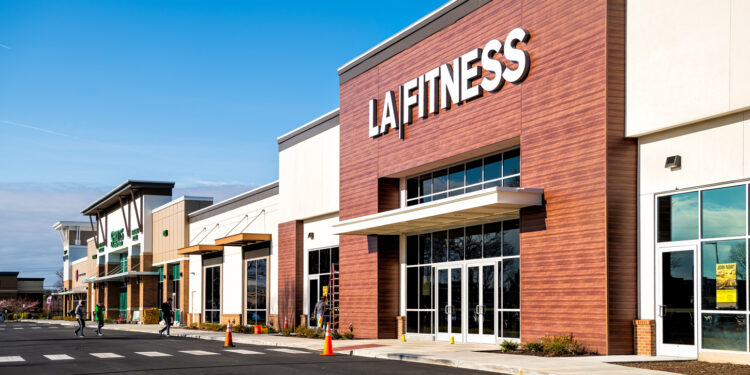
The fitness industry is driving a historic shift in tenant real estate. Here’s what it means for club owners looking to grow.
For the first time ever, service-based businesses — not goods-based retailers — leased most of the retail square footage in the U.S. last year.
According to data firm CoStar, service tenants accounted for just over 50% of total retail leasing in 2025, up from 40% 15 years ago. And fitness centers are leading the charge.
Reporting by The Wall Street Journal (WSJ) found that fitness center openings made up nearly 30% of all service-based leases in 2024 — up from 20% in 2016. That is not a blip. That is a structural shift, and it has major implications for health club operators thinking about their next location, lease negotiation or expansion play.
Why Retail Landlords Are Courting You
The collapse of traditional retail — accelerated by e-commerce — has left landlords with a problem: empty big boxes and shrinking anchor tenants. E-commerce accounted for 16.4% of total U.S. retail sales last year, according to the U.S. Department of Commerce, compared with roughly 8% in 2016. Clothing stores, shoe retailers and drug chains have all pulled back.
That has made fitness operators an attractive replacement. Planet Fitness, for example, has opened clubs in spaces vacated by bankrupt retailers such as Rite Aid and craft-store chain JoAnn Fabrics, according to WSJ. The chain plans to open nearly 200 new locations in 2026 after adding approximately 1.1 million net new members in 2025.
Consumer spending on services is expected to remain strong, according to CoStar analysis cited by WSJ, with no signs of a reversal on the horizon. For club owners and operators, that dynamic creates negotiating leverage that simply did not exist a decade ago. Landlords need you and the foot traffic you bring more than ever.
The Wellness Economy Is Your Tailwind
The broader wellness market totaled $2.1 trillion in the U.S. in 2024, according to the nonprofit Global Wellness Institute, which tracks spending across sectors including fitness, spas, nutrition and mental wellness.
That figure reflects a consumer whose priorities have fundamentally changed. Spending on experiences like yoga classes and personal training has become the new status signal — replacing the designer handbag as a marker of aspiration. The shift is showing up in lease economics, too. Shopping center owners are actively subdividing vacated retail space to accommodate smaller wellness and fitness tenants, who collectively generate stronger foot traffic and higher rents per square foot than the single-use retailers they replaced, according to WSJ.
That is the pitch landlords are now making to service tenants. Health clubs that understand this dynamic can use it at the negotiating table.
Social Media and GLP-1s Are Driving Membership Demand
Club owners are benefiting from two powerful demand drivers converging at the same time.
Social media has intensified Americans’ focus on appearance and physical performance, fueling demand for everything from boutique fitness studios to blow-dry bars. That same cultural pressure is bringing new demographics through gym doors and raising the overall floor for wellness spending.
The rise of GLP-1 medications such as Ozempic is adding another tailwind. For example, In‑Shape Fitness started working with KORB Health, a virtual health care provider that offers convenient and affordable access to personalized wellness programs and prescription therapies in August 2025. KORB gives In-Shape members discounted access to personalized GLP‑1 weight loss treatments, along with additional wellness programs and clinical services to support their health goals.
For operators, this is an opportunity to market directly to a demographic that is motivated, health-conscious and actively looking for the next step in their wellness journey.
The Social Gym Is Back and It’s a Growth Strategy
Post-COVID-19 pandemic socialization is reshaping how members use their clubs, and operators on the front lines said 2025 made that more clearer than ever.
For Chris Craytor, the CEO of acac Fitness & Wellness Centers and Welld Health, last year confirmed a timeless truth: people crave in-person experiences.
“My biggest takeaway from 2025 was not a new lesson, rather a reaffirmation of the power of human connection as a key factor in the continued growth of our industry,” said Craytor. “The in-person experiences we create within and outside of our walls are meaningful antidotes to a world where technology can increasingly push us further apart.”
That hunger for connection is reshaping operations. Craytor pointed to the rapid expansion of wellness and recovery brands and the creative use of club space to meet rising demand for social wellness elements such as saunas and cold plunges.
That positioning is a strategy worth examining for any operator. Clubs that build community, not just programming, attract members who stay longer and refer more often.
What This Means for Your Next Location
Retail vacancy nationwide sits at 4.4%, near record-low levels, according to CoStar, but that figure is being held up by service tenants filling spaces that goods retailers are abandoning. That means prime real estate is available in centers that are actively being repositioned around wellness and services.
For health club operators, the takeaway is clear: you are no longer a niche tenant. You are a desirable anchor. Use that status to negotiate better lease terms, seek co-tenancy with complementary wellness brands and evaluate spaces that traditional retail has left behind.
Reporting sourced from The Wall Street Journal. Additional data from CoStar, the Global Wellness Institute and the U.S. Department of Commerce.