


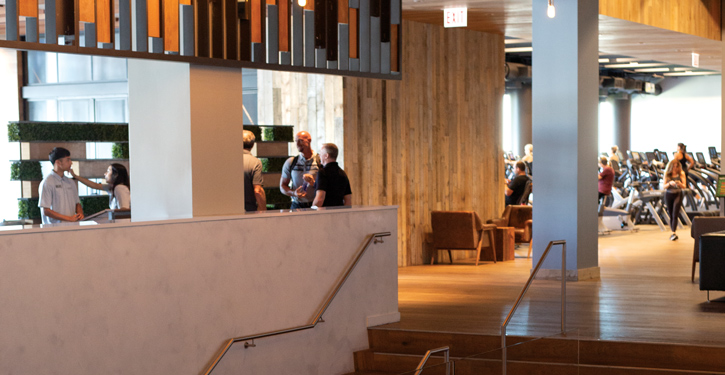
As 2025 winds down, health club leaders are taking stock of a year that underscored the industry’s resilience and potential. The past 12 months reinforced the value of human connection, accelerated the rise of holistic wellness and sharpened the need for strategic clarity. Looking ahead to 2026, operators see both opportunity and responsibility: to meet evolving member expectations while charting growth in a shifting economic landscape.
To gauge the industry’s pulse, three seasoned executives shared what they’ve learned and where they see health clubs headed next.
The Power of Human Connection
For Chris Craytor, the CEO of ACAC Fitness & Wellness Centers and Welld Health, 2025 confirmed a timeless truth: people crave in-person experiences.
“My biggest takeaway from 2025 was not a new lesson, rather a reaffirmation of the power of human connection as a key factor in the continued growth of our industry,” said Craytor. “The in-person experiences we create within and outside of our walls are meaningful antidotes to a world where technology can increasingly push us further apart.”
That hunger for connection is reshaping operations. Craytor points to the rapid expansion of wellness and recovery brands and the creative use of club space to meet rising demand for social wellness elements such as saunas and cold plunges.
Strategic Discipline in a Competitive Market
Jon Brady, the president of Midtown Athletic Club, also emphasized the industry’s shift toward holistic wellness. “It’s not what you look like, it’s how you feel about what you look like,” he said. For 2026, he predicts “social wellness — the power of community and groups and the role we as an industry play in that is both powerful and an incredible opportunity.”
One large lesson Brady learned in 2025 was the importance of intentional strategy.
“Be very intentional about your strategic direction,” said Brady. “Make decisions about what you’re not and don’t do as clearly as you make decisions about what you are and what you will do.”
This discipline is critical as health clubs face broader competition — from boutique studios and recovery lounges to apartment complexes and corporate gyms. Leaders can no longer win on equipment alone; they must define what sets their clubs apart and invest in that unique value.
Broadening the Definition of Fitness
Sue Boreskie, the CEO of Reh-Fit Centre in Winnipeg, Canada, echoed Brady’s sentiments. She has watched member expectations expand beyond traditional fitness.
“Members continue to look for more from fitness centers,” explained Boreskie. “In addition to a variety of exercise equipment and programs, they’re looking for social spaces and events, places to plug-in and work, recovery equipment, recreational activities, qualified staff to guide them, and relaxation spaces.”
Competition now extends far beyond other gyms. “The environment is more competitive than ever,” added Boreskie. “Condo and apartment buildings, companies, and golf courses are getting quality exercise equipment. Our competition is much broader than just fitness centers.”
She believes members want to see improvements, so capturing outcomes to show progress helps demonstrate the work they do in the gym is worth it. Members are reading that if they want to live a long healthy life and be independent for many years, exercise is a key solution.
Her team has also found demonstrating measurable outcomes — showing members how exercise supports long-term independence and healthy aging — helps sustain engagement. Boreskie emphasized the continued popularity of pickleball and mind/body programming isn’t going to slow down any time soon.
Key Trends to Watch in 2026
All three executives see 2026 as a pivotal year shaped by both economic and social forces.
Interest rate shifts. Craytor believes the financial climate will influence growth. “As rates move downward as expected, will this release some cash that has been sitting on the sidelines? Will lower rates encourage operators to borrow more to expand?” he asked.
Social wellness and community. Brady highlighted the growing demand for clubs to serve as hubs of belonging. “Members are looking for ‘more’ from us,” he said. “Not more equipment, but more connections, more spaces to use for different aspects of their lives and more interactions.”
Health outcomes and guidance. Boreskie expects a surge of newcomers to fitness centers who “know little about exercise and will need more guidance from our industry professionals.” She also predicts continued emphasis on demonstrating the health benefits of fitness and the critical role of social connections.
Adapting to Shifting Member Expectations
Across the board, operators report that today’s members — especially millennials and Gen Z — are willing to invest significantly in fitness and wellness services. According to an ABC Fitness report, despite their lower income, Gen Z report spending between $25 and $74 a month on fitness, while millennials are higher than average in the $75-$150 range. However, these generations also expect personalization.
“Legacy businesses will need to continue to adapt to meet the needs and preferences of the millennial and Gen Z cohorts, while not alienating existing Gen X and order members,” said Craytor. “We’re adapting by offering more experiences and events designed to cater to different demographics, in order to meet the increasing need for personalization of offerings.”
Boreskie agreed with Craytor that operators cannot underestimate the importance of personal touches in an era saturated with digital options.
“Now that there are many options in technology, the differential that needs to be pursued would be the personal connections with calls and asking them how they are doing when at the center,” explained Boreskie. “A handwritten note or a one-on-one meeting will make a difference.”
Lessons for Operators
When asked for their best advice to peers, the leaders offered actionable takeaways:
Define your secret sauce. “Ensure that all programs, facilities and customer experiences are aligned with your brand and its pricing model,” advised Craytor. “Rather than try to emulate others, take the time to understand your own ‘secret sauce’ and focus effort on what makes your offering unique.”
Use technology strategically. Brady recommended a targeted approach to emerging tools such as AI. “Develop use-case scenarios for adopting new technology,” he said. “Don’t ask, ‘how can I use this technology?’ Ask, ‘what problem do I have and what part of this technology could help me solve this problem?’”
Never settle. Boreskie urged operators to keep raising the bar. “Don’t be satisfied with your current success but striving for that next level service,” she said.
The Road Ahead
If 2025 reaffirmed anything, it’s that health clubs thrive when they deliver far more than workouts. They’re community anchors, recovery hubs and catalysts for healthier living.
To succeed in 2026, operators must blend strategic discipline with bold innovation: refining their brand promise, investing in social wellness spaces and proving the health outcomes that members and increasingly health care partners are seeking.
As Craytor put it, the challenge and opportunity lie in understanding what makes your club unique and leaning into it. The clubs that do will not only weather economic shifts but help shape the next chapter of the industry’s growth.





![From Client to CEO: Bryan Myers and the Rise of [solidcore]](https://d296qbqev3kq48.cloudfront.net/wp-content/uploads/2025/11/06151333/CS-NovDec25-CoverStory-3-75x75.jpg)
