
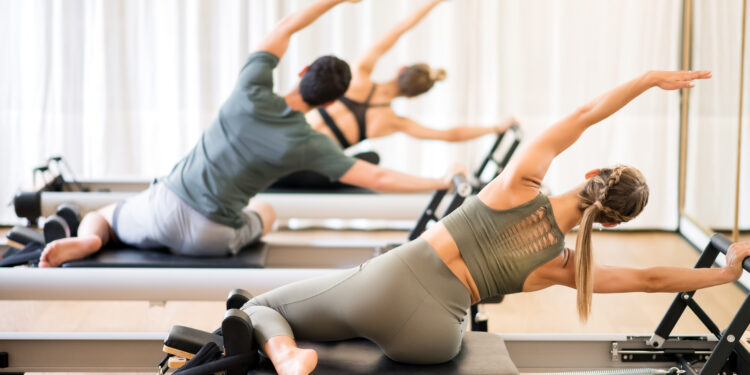
Industry professionals share their thoughts on the boom of reformer Pilates and how to incorporate it into facilities as the demand grows.
The surge in reformer Pilates is reshaping both boutique studios and multipurpose clubs, creating new opportunities — and complexities — for operators seeking to meet demand.
In the latest Thought Leaders panel, industry leaders unpacked what’s driving Pilates’ momentum, how clubs and boutiques differ in execution, and what ultimately defines success with this modality. Their insights offer a clear picture: reformer Pilates is growing not solely because of consumer interest but because operators now understand its potential for member retention, brand identity and high-quality experiential fitness.
While Pilates is hardly new to the fitness industry, the current boom is undeniable. Operators across the country are experiencing unprecedented interest, and according to the panel, several forces have created this moment.
For Kory Angelin, the president and COO of CoreHaus Fitness, social media has been impossible to ignore. “How many times have you scrolled and saw someone doing something insanely interesting on a reformer,” he asked.
The mystery and visual appeal of the equipment haven’t just intrigued consumers but has also created an opportunity for brands to educate members on what they are doing and why they are doing it when it comes to reformer Pilates.
Beyond visibility, Pilates stands apart from other popular modalities due to its accessibility and high-touch nature. “You can’t just go out and buy a reformer and do it at home,” said Angelin, describing it as “insulation proof” compared to treadmills, spin bikes and weights. This specialized barrier naturally drives more people into studios and clubs, especially after the COVID-19 pandemic’s saturation of at-home options.
Kamille McCollum, the president and co-founder of BODYBAR Pilates and owner of three studios, pointed to the role leading brands in expanding access. Before, people had to pay more in order to experience Pilates because it was smaller and cost clubs more to have. Growth in franchises demonstrates that group reformer could be both scalable and profitable, widening the audience that once saw Pilates as exclusive.
McCollum also highlighted a shift in member mindset. After the COVID-19 pandemic, she said, people began looking for movement that wasn’t always high intensity. “There’s just become more of a balance in how people see where movement can be,” she said.
With today’s renewed emphasis on functional strength, McCollum noted that reformer Pilates fits neatly into this cultural moment. “You absolutely get some of those dynamics whenever you’re on the reformer, personalizing your springs and having instructors educate the clients on how we can help you achieve that,” she said.
From the club perspective, Jennifer Hogg, the director of group exercise at East Bank Club, noted that Pilates’ multifaceted nature beyond the reformer itself. “There’s lots of different ways to do Pilates. Some people should start on the mat, some people need a barrel, a chair,” she said. While reformer Pilates dominates conversation today, Hogg emphasized the value in helping members find the best avenue to practice Pilates for the client.
As reformer Pilates expands across both studios and multipurpose clubs, the panelists discussed their advantages and challenges on each side.
For clubs, Hogg described the benefits of scale and flexibility. Although East Bank operates at a scale different than most clubs, she noted they offer multiple studios, a variety of equipment and both complimentary and fee-based formats. This creates an environment that supports members at every stage. “Wherever any member is, there’s a safe place for them to land,” she said.
Boutiques, however, excel in consistency and community. “It does give that more community feel,” said McCollum. BODYBAR instructors are trained to deeply understand client needs and match them with one of the brand’s seven class formats. That structure ensures class experience remains uniform. Members know exactly what they’re walking into. “All the BODYBAR class formats have a method to the madness,” she said.
Angelin agreed, saying he entered the boutique world for the experience it can control. “People don’t buy what you do,” he said. “They buy why you do it.” Every touchpoint matters — from language and ambiance to personalized coaching.
But boutiques have limitations, too. “It is one service,” said Angelin. With waitlists and limited variety, operators must accept that exclusivity can be both a strength and a challenge. Many members offset this by maintaining multiple memberships, which Angelin sees frequently.
As more operators consider investing in reformers, metrics for success are top of mind. The focus has been on whether that is from aspects like full classes, utilization or profitability. According to the panelists, the answer is more nuanced.
From a franchisor perspective, McCollum urged operators to look beyond class occupancy and consider retention. “One thing that gets missed a lot is attrition — making sure you’re keeping your clients,” she said. Consistency in community and experience helps members form habits and relationships, which supports long-term membership value.
Conversion is another overlooked component. McCollum shared that for most consumers, conversion isn’t going to happen immediately. Instead, purchases typically follow two to three sessions. That means operators need strong re-engagement processes to get prospects back in quickly, particularly in the early phase of their interest.
Hogg defined success by member outcomes. “When the member gets the results, they’re looking for, they move differently in the world,” she said. “They’re kinder. They’re easier to be around.” Results drive referrals, which in turn fuel community, retention and long-term program stability.
At East Bank, high-quality instruction is non-negotiable. Hogg described extensive education requirements — four-year degrees, multiple certifications and hundreds of training hours — to ensure safe, effective programming. With well-trained instructors, she noted that members get the results that they’re looking for.
Though not discussed as explicitly as programming, profitability was an underlying theme in the conversation. The panel emphasized how high-quality instructor training can be expensive and require ongoing development, reformers can be costly upfront and require maintenance, the ROI on reformer space hinges on utilization and retention, and fee-based formats are strong revenue drivers but require consistent delivery in order to justify the pricing.
Whether boutique or club-based, operators must think long-term about how reformer Pilates fits into their brand, staffing, and customer journey.
The Pilates boom is not just another trend but a strategic opportunity for operators. Through this discussion, the panel emphasized that reformer Pilates succeeds when operators focus on experience, education and outcomes rather than just adding equipment. Members aren’t seeking another workout — they’re seeking instruction, community and transformation.
Watch the full conversation below.