The American College of Sports Medicine just published its first updated position stand on resistance training since 2009, and the findings challenge some the most widely held assumptions in the fitness industry.
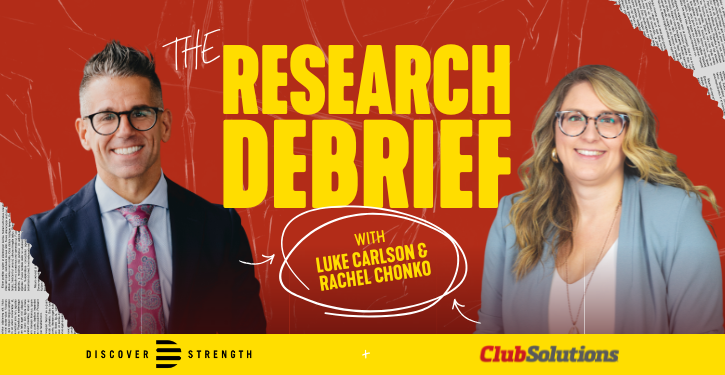
In Episode 13, hosts Rachel Chonko and Luke Carlson break down the ACSM’s new paper which synthesized more than 30,000 studies published over the last 15 years. The conclusions are clarifying with direct implications for how health clubs program, communicate and coach.
Listen:
What This Episode Covers
This episode breaks down the ACSM’s new position stand — Resistance Training Prescription for Muscle Function, Hypertrophy and Physical Performance in Healthy Adults — and what it means for fitness professionals on the floor.
Key discussion points include:
- Why the 2009 position stand was widely criticized for lacking evidence-based rigor and what changed in the new methodology.
- The eight scientifically validated benefits of resistance training, from muscle strength and endurance to gait speed, balance and power — and why it matters across the lifespan.
- What actually drives muscle hypertrophy and what doesn’t.
- Why progressive overload remains the single most important variable in any resistance training program.
- The case for minimal effective dose: why three exercises, once or twice a week, can produce meaningful results and why that message could change participation rates.
Why This Matters For Operators
The ACSM’s updated position stand isn’t just a research document. It’s a programming and messaging mandate for the fitness industry. The paper is clear that decades of conventional guidance has overcomplicated resistance training in ways that may have actively discouraged participation. For operators, this represents both a correction and an opportunity.
The research affirms that a significant portion of the population, particularly older adults, avoids strength training based on misperceptions about injury risk and complexity. Clubs that simplify their messaging, lower the perceived barrier to entry and lead with the science are positioned to reach members who have historically been disengaged from resistance training programming.
Key implications for operators include:
- Re-examining how strength training programs are structured and marketed — accessibility and simplicity are now scientifically defensible positions.
- Updating staff education to reflect current evidence, particularly around load selection, exercise frequency and the primacy of progressive overload over rigid periodization schemes.
- Building programming and coaching language, specifically for older populations who have the most to gain from resistance training and the most to lose from inactivity.
- Using the ACSM’s credibility to reinforce member conversations with physicians.
Resistance training is for everyone. It doesn’t have to be complicated and the results are profound. Clubs that build their programming philosophy around that message are well-positioned to serve a broader, more engaged membership base.
Listen or Watch
Audio: Available on SoundCloud, Apple Podcasts and Spotify.
Video: Watch the full episode on YouTube.
Research Referenced in This Episode