Something has shifted in the way people train. Walk the floor of any major fitness trade show and you feel it: the language of competition has moved from the fringes into the mainstream. Concepts once reserved for elite athletes — race-day programming, qualifier rounds, performance hubs, etc. — are now being built into the core offerings of health clubs, big-box franchises and boutique studios alike.
The question for club operators is how to navigate a landscape that is growing faster than almost anyone predicted and getting more crowded by the season.
The Hybrid Fitness Boom
To understand where things stand, start with the numbers.
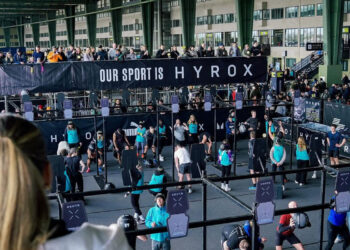
HYROX — the indoor fitness racing format that combines both running and functional workout stations, where participants run one kilometer, followed by one functional workout station, repeated eight times — has become the standard-bearer of the hybrid competition movement. Started in 2017, it’s now one of the fastest-growing competition sports on the market, achieving roughly $140 million in revenue for 2025 according to Medium. The athlete pipeline feeding that revenue has expanded dramatically: over 750,000 athletes participated in the 2025 season — growth of more than 100% compared with 2024 — across 80 events in 31 markets.
The growth story on the gym side is equally striking. In March 2023, HYROX had just over 800 affiliated gyms worldwide. According to Atsource Manufacturing, HYROX’s affiliate network has tripled in 12 months, climbing from 2,500 partner gyms in early 2024 to 8,500 by mid-2025. For club operators, that number represents both an opportunity and a strategic signal: the fitness consumer increasingly wants a destination for their training, not just a space to sweat.
The Major Players Go In-House
What makes this moment particularly interesting is that the industry’s largest brands aren’t just watching hybrid fitness competitions grow, they’re building their own ecosystems.
Life Time recently launched HYBRID XT, a group training program designed for the explosive growth of hybrid-style fitness where strength, endurance and athletic movement converge.
The program blends conditioning and cardiovascular work — running, rowing, SkiErg, assault bike — with functional strength using barbells, dumbbells, sleds and bodyweight training. The explicit design intent is to connect in-club training with Life Time’s LT Games, a multi-stage competition testing total athleticism across strength, endurance and functional movement.
“What I love about HYBRID XT is that it trains everyone like athletes, not just competitors,” said Juan Herrera-Perla, the brand leader for HYBRID XT. “The combination of conditioning and strength helps you work harder, recover better and move with more confidence. Members at any level will notice they’re getting stronger, faster, and more capable inside and outside the club.”
The Life Time model illustrates a larger trend: the most strategically sophisticated operators are building closed-loop systems where programming, community and competition reinforce each other. Members don’t just train at the club, they train toward something and the destination is an event the club itself owns.
F45 Training is taking a similar approach with its new PEAK500 format, a 30-minute hybrid workout built around five stations: bike erg, a dumbbell circuit combining devil’s press and suitcase lunges, ski erg, a combination of shuttle sprints and thrusters, and a row erg. The format can be completed individually or in pairs and is designed as a measurable performance test —progress that can be tracked, compared and competed against over time.
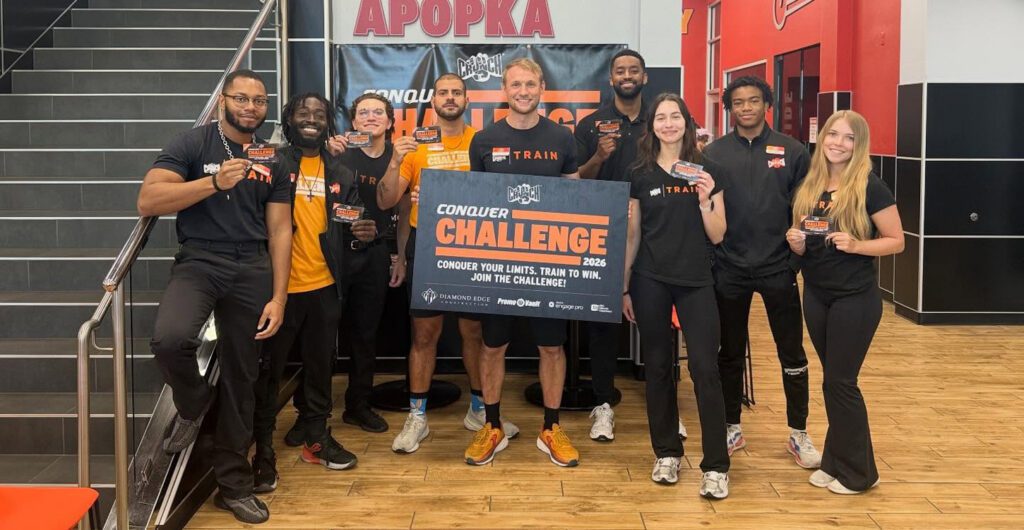
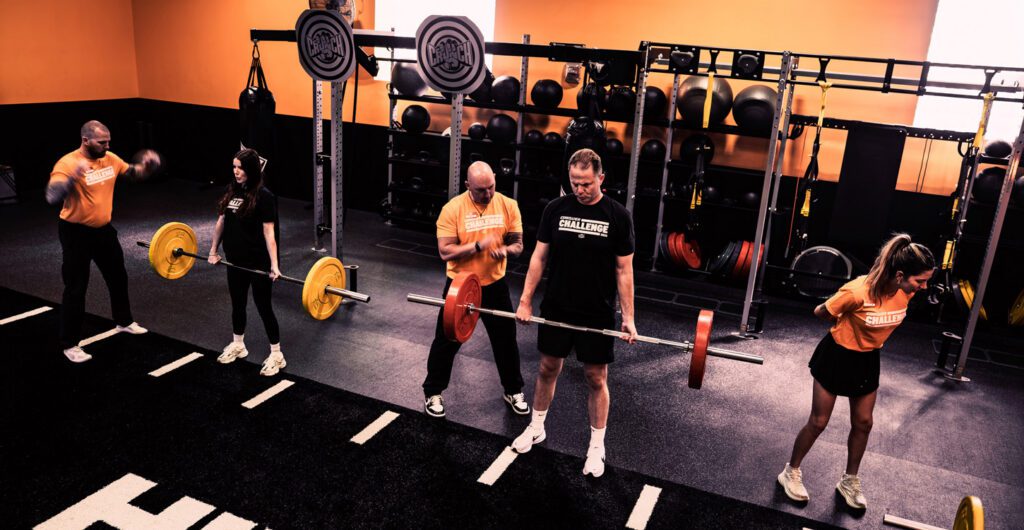
And CR Fitness Holdings, the largest Crunch Fitness franchisee, is going even further with its Conquer Challenge — a three-phase competition running April through June across all 93 participating locations. With $17,000 in cash prizes, qualifier rounds on June 6 and regional finals on June 20, the program has the architecture of a serious competitive event. For a $50 registration fee, members receive entry, two personal training sessions, a kickoff experience and a branded athlete T-shirt. This a bundle designed to maximize both perceived value and club engagement.
“At Crunch, we’re always looking for new ways to challenge and support our members,” said Tony Scrimale, the CEO and co-founder of CR Fitness Holdings. “The Conquer Challenge is more than a competition, it’s an opportunity for members to train with purpose, build confidence and experience the power of community inside our clubs.”
The Conquer Challenge is deliberately open to all fitness levels — a design choice that points to one of the central strategic questions in this space.
The On-Ramp Question
For all the momentum behind fitness competitions, one question keeps coming up among operators: does this bring new people through the door, or does it just excite the members who were already going to stay?
It’s a question worth asking directly, because the answer shapes the business case. HYROX, Life Time’s LT Games, and similar large-format events are primarily served by a consumer who already trains consistently and is looking for a performance goal. The community is passionate and high spending but it’s not a wide-open acquisition channel for the average commercial gym.
The operators making the most interesting moves are the ones thinking explicitly about the on ramp. CR Fitness Holdings built the Conquer Challenge to be open to all members, supported by certified personal trainers acting as coaches and referees throughout the event. The structure is welcoming by design — the competition is a vehicle for deeper engagement with personal training and community, not a filter for the already-fit.
What This Means for Club Operators
For operators still deciding how — or whether — to engage with the fitness competition trend, a few strategic considerations stand out.
Affiliation is a real business decision. The HYROX affiliate model offers genuine value: digital programming, certified coaching education and the brand halo of association with the fastest-growing fitness competition property in the world. Global affiliations grew at 260% per annum, with over 2,300 new clubs affiliated in a single year. The clubs joining aren’t all specialty training facilities — large franchise networks are increasingly part of the mix. The question isn’t whether affiliation is worthwhile in principle; it’s whether your member demographic and staff capacity make it the right investment at this moment.
Building proprietary competition IP has real upside. The CR Fitness Holdings model demonstrates that a large franchisee can create a competition event that builds member loyalty, drives personal training revenue and generates marketing energy entirely within its own ecosystem. The competitive landscape with external events doesn’t complicate that story; it validates consumer appetite for structured competition and lets the club capture that demand internally.
Programming and competition are converging. Life Time’s HYBRID XT and F45’s PEAK500 reflect a broader shift: the class schedule is increasingly a performance pathway, not just a service offering. Members who train with a competitive goal in mind have higher retention, deeper engagement with coaching staff and stronger community ties. That’s documented in how these programs are being built and marketed.
The Bigger Picture
The fitness competition wave is not a niche phenomenon waiting to peak. Over 80 global HYROX races took place in 2025 seeing over 550,000 athletes and 350,000 spectators. Major brands from Puma and Red Bull to BYD are building sponsorship strategies around fitness competition audiences. Clubs that have integrated competition programming are reporting stronger engagement metrics and member retention data than those that haven’t.
What’s most significant isn’t any single format or brand. It’s the underlying consumer shift: fitness has become something people want to do toward something, not just for something. The goal-oriented, measurable, community-anchored experience of competition regardless of the format is meeting a genuine and growing demand.