Recovery used to be an afterthought. A foam roller in the corner. A bucket of massage guns near the exit. But for Shaun Grove, the industry veteran who spent nearly two decades building some of boutique fitness’s biggest franchise brands, that approach represents one of the sector’s most glaring missed opportunities.
Grove previously served as president of Club Pilates from 2015 to 2021 and later led Rumble Boxing under the Xponential Fitness. After departing Xponential in 2024, Grove acquired STRIDE Fitness — a treadmill-based interval training concept — and set about rebuilding it from the ground up, with recovery baked into the model from Day One.
The Gap in the Market
Grove is blunt about what he sees when he looks across the boutique fitness landscape: too few operators take recovery seriously and those who do often approach it in a fragmented way.
“Too few really offer it,” said Grove. “You still see very few boutique fitness studios that offer anything outside of maybe some guided stretching or some therapy guns or something along those lines.”
The big-box gym world has moved further along — saunas, cold plunges, dedicated wellness floors — but Grove argues those facilities miss something equally important: the personal touch that defines boutique fitness.
“The big box has kind of missed the personal touch of it,” explained Grove. “They’ve got it for you, go use it. But they don’t really integrate the way they should from a human perspective, like we do at the boutique fitness level. But then at the boutique fitness level, they don’t have the footprint to really be able to do what they’re doing at the big box side.”
STRIDE Fitness, Grove believes, occupies the space between those two worlds.
Building the Recovery Zone
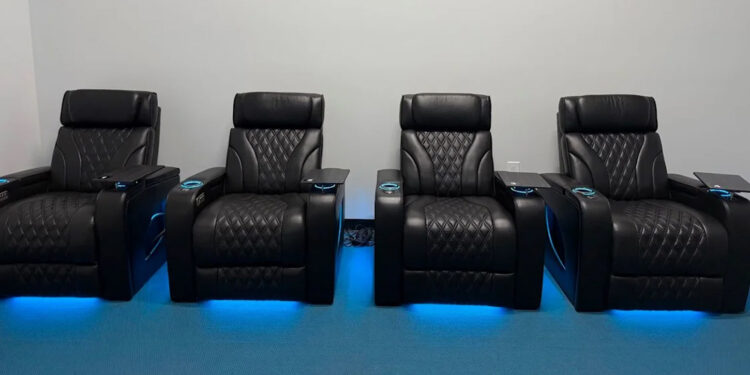
At STRIDE’s flagship studio in Huntington Beach, Califorina, the recovery offering isn’t a rack of equipment shoved into a hallway. It’s a dedicated room the brand calls its Recovery Zone, built to complement its cardio- and strength-focused group classes.
The zone includes anti-gravity massage chairs with Hyperice air compression therapy, myofascial release and trigger point tools, red light therapy paired with motion plates, and self-guided stretching areas.
“We’re trying to create as much of a recovery component as you can within the footprint that you can dedicate to it,” said Grove.
Studios are sized between 2,000 and 2,800 square feet, with the Recovery Zone carved out intentionally during the design phase — not retrofitted. Grove said existing boutique operators face a harder path to adding recovery space, often ending up with lobby installations or equipment bolted to cardio machines.
“I think as new units open, you’re going to start to see a lot more of this because people appreciate it and they realize it’s a necessary part of that kind of holistic fitness journey — the recovery component that has been lacking for a long time,” said Grove.
Integration, Not Obligation
Having the equipment is only part of the equation. Grove’s model is built around driving actual utilization with a focus on getting members to use the Recovery Zone consistently, not just occasionally.
Recovery access is tiered across three membership levels: Ignite, Core and Elite. The top-tier Elite membership includes unlimited recovery access alongside unlimited classes. Core members receive a set number of monthly recovery sessions, and all new members — regardless of tier — receive a guided recovery orientation with a head coach during their onboarding.
“With every membership regardless of what type you have, our head coach will take you through the recovery component and show you how to use every piece of equipment, why you use it and how often you should use it,” said Grove.
The goal is to close the loop between training and recover, and Grove said, to address one of fitness’ persistent retention problems: the member who pushes hard, gets sore and doesn’t come back.
“We encourage you to go into this recovery room after your workout, before your workout, and really rejuvenate your body to a point where you can come back that next day and be excited to do it,” explained Grove.
Advice for Operators
For boutique operators looking to add or expand recovery offerings, Grove’s message is straightforward: be deliberate.
“Really think about it and make it intentional before you just jump in and add things,” said Grove. “There should be a why behind your decision to incorporate recovery. Do it in a way that’s meaningful, do it in a way that’s impactful for your members — maybe even consult your members on what it is they want and what would be the most beneficial.”
On recovery equipment, he recommended prioritizing high-impact, low-footprint modalities. Air compression therapy tops his list for return on square footage. He steers away from cold plunges and saunas for boutique-scale operations, citing the cleanliness protocols, staffing overhead and space requirements those amenities demand.
“For me, it was really looking at what are the best bang-for-your-buck type of modalities that can be put in there,” said Grove.