
Explore how operators are moving beyond workouts to build fitness businesses centered around whole-person wellness.
For decades, fitness businesses were built on a simple promise to deliver great workouts. But as the industry shifts toward whole-person well-being, operators who continue to anchor their value solely in exercise risk being left behind.
Today’s consumer expects more — more support, more connection, more recovery and more balance. And increasingly, clubs that embrace holistic health as an operational strategy rather than a buzzword are discovering a powerful differentiator.
Two leaders focusing on this shift are Daniel Stickler, the CEO of The Covery Health, and Derek Gallup, the founder of SPARKLE and longtime fitness executive. . Alongside research compiled by Dr. Karlie Intlekofer, a global research scientist at Matrix Fitness, their insights highlight a clear message to operators: holistic health is no longer optional.
A Systems-Based Strategy — Not a Spa Add-on
Stickler emphasizes that holistic health isn’t a marketing angle but an operating model. It must be built into the very architecture of a club’s operations.
“Holistic health means optimizing the entire human system including hormones, metabolism, recovery, aesthetics and lifestyle all under one integrated, medically-guided platform,” said Stickler. “It’s central because it creates better outcomes, stronger retention and a scalable ecosystem rather than one-off services.”
For operators, that integrated approach solves a core business challenge. As consumers seek recovery, longevity, stress management, and emotional well-being, they often bounce between gyms, med spas, at-home tools and digital platforms. Stickler believes clubs can reclaim that ground by providing a cohesive, medically-informed journey.
This requires discipline in modality selection. “We prioritize modalities that are evidence-based, medically relevant, high-ROI and synergistic,” said Stickler. His goal is not to offer everything, but to create an intentional experience framework where recovery supports training, aesthetics complement performance and lifestyle coaching fills gaps traditional fitness may not address.
But intentionality isn’t only about adding the right modalities. It’s also about making sure existing offerings are clearly aligned with outcomes members actually feel and value. “Holistic health doesn’t always require additional services,” said Intlekofer. “It requires clearer alignment between what clubs already do well and how those outcomes are communicated.”
The financial upside is meaningful. According to Stickler, “Holistic and optimization models increase frequency, cross-utilization and retention resulting in higher margins and lifetime value. Traditional models rely on transactional visits; holistic platforms build annuity-style revenue.”
For operators facing rising acquisition costs and increased competition, annuity revenue and longer engagement are not just attractive — they are essential.
Designing Experiences that Support the Whole Person
Where Stickler offers a systems-driven, medicalized model, Gallup brings an emotionally anchored perspective shaped by personal tragedy. SPARKLE — his initiative supporting mental health through activity, recovery and education — emerged from the loss of his wife, Carla, who died by suicide. The experience transformed how he views the industry’s role.
“There wasn’t a focus on activity, it was a focus on talking,” said Gallup, regarding his early interactions with mental health organizations. “So, as I started to think about what could help, No. 1 was activity.” But he quickly realized movement alone isn’t enough.
SPARKLE — which stands for suicide prevention through activity, relaxation, kindness, laughter, and education — creates an experience ecosystem addressing mental, emotional and social needs. The fitness industry is uniquely positioned to meet those needs.
His vision frames clubs not as workout destinations, but as holistic support environments. Inside UFC Gym, where he previously served as executive vice president, Gallup saw recovery zones evolve into community hubs. “They became this third place,” he explained. “People wanted to stay longer because it feels good. Not just for the body, but for the soul.”
This shows experience design as creating spaces that support belonging, emotional decompression, habit formation and connection.
“Relationships formed inside the facility are among the strongest drivers of member loyalty,” said Intlekofer. “Supportive interactions create a sense of safety and belonging that transforms a club from a place to work out into a social hub.”
Social Connection as a Business Asset
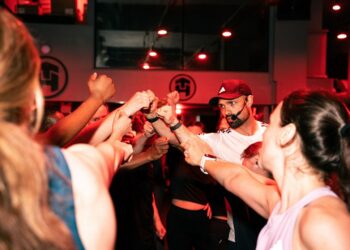
The operational impact of holistic programming is perhaps most evident in the way it activates the community. SPARKLE’s partnerships with Spartan Races and DEKA events provide a clear example.
At several clubs, these events drew large crowds with a significant portion being non-members. “We typically find that 30% or more of the people coming to do the events were not members,” said Gallup. For operators, that’s built-in lead generation wrapped in authentic community outreach.
But the biggest impact comes from team-based participation. “The more we create community and have big team events, the more we get people physically active,” said Gallup. “There’s so much hard data showing the more we’re active, the better our mental health is.”
Team formats don’t just motivate members but deepen relationships between staff and members. At one event, every general manager and fitness manager competed as a team. “Once you’ve got management participating, everyone starts talking about it — the laughter and the fun get people engaged,” said Gallup.
This is the fusion of culture, communication and operational strategy operators often chase but rarely capture in a program that improves mental well-being, strengthens community bonds, generates leads and amplifies brand identity.
Building a More Emotionally Intelligent Fitness Business
Holistic health also requires operators to navigate mental and emotional well-being with authenticity. For Gallup, without real purpose, programs fall flat. “If you’re doing it just because you feel like there’s a business opportunity, I don’t find it successful. It’s not authentic,” he said. “There’s got to be a real reason behind it.”
Authenticity is also central to education and communication strategy — an area Stickler sees as operationally critical. At The Covery, every guest experience begins with reframing the narrative. “We lead with outcomes, not modalities,” he said. “Combined therapies accelerate recovery, improve adherence and compound results.”
This creates a more empowered, knowledgeable member who understands not just what they are doing, but why it matters.
“Improvements in fitness, strength and social connection all support mental well-being, but clubs often communicate these outcomes narrowly,” said Intlekofer. “Remind members these are core drivers of enjoyment, confidence and healthy stress management. Making these links explicit helps members understand why the facility visits help them feel better, not just why they may look or perform better.
The Future: Medicalized, Integrated and Human-Centered
Both leaders are clear about where holistic health is heading.
“Over the next three to five years, holistic health will become more medicalized, data-driven, membership-based and integrated with virtual care,” said Stickler.
Gallup sees operators becoming catalysts for emotional well-being in ways the industry has never fully embraced. “There’s an opportunity to talk about mental health in the same breath as physical health,” he said.
For operators, that alignment represents the next evolution of member experience where fitness, mental health and lifestyle support aren’t separate ideas but part of one continuous wellness plan.
As competition intensifies, operators must differentiate by meeting more dimensions of human need, not just adding new equipment and classes. The clubs that thrive in the future will be the ones designing for the whole human — physically, mentally, emotionally and socially.